

Andrew Devall
Most businesses don't set out to send mixed messages. It happens slowly.
A new social post goes up with a different tagline.
The radio spot pushes a promotion the website never mentions.
The Google listing still shows last year's hours.
None of these feel like a big deal on their own. Together, they make a business harder to recognize and harder to trust. Customers don't see your marketing one piece at a time the way you do. They see all of it, mixed together, and they fill in the gaps themselves.
As the year winds down and next year's plans take shape, it's a good moment for an honest gut-check. This brand consistency checklist takes about 10 minutes. You don't need a marketing team to complete it. You just need to look at your brand the way a customer would.

Key takeaways
-
Brand consistency covers five areas: your message, your look and sound, your offers, your timing, and your customer experience.
-
Score 10 statements from 0 to 2 to find where your brand is drifting.
-
Fix your lowest-scoring area first, then set the elements that shouldn't change before you plan next year's campaigns.
What is brand consistency?
Brand consistency means your business looks, sounds, and behaves the same way everywhere a customer runs into it. That includes your ads, website, social media, signage, and the experience someone has when they call or walk in.
It's more than matching logos. At Leighton Engage, we break it down using the Bricks and Mortar Strategy, the same approach we use to build campaigns across Leighton Engage and Leighton Media. Bricks are the individual messages that change often: this month's offer, a seasonal promotion, a new service. Mortar is what never changes: your core promise, your colors, your voice, and the experience customers can count on. For the full breakdown, read what brand consistency actually looks like across channels.
This scorecard checks your mortar. When the mortar is solid, every new brick you add strengthens the brand. When it's cracked, even great campaigns start to feel like they came from different companies.
How to score your brand consistency in 10 minutes
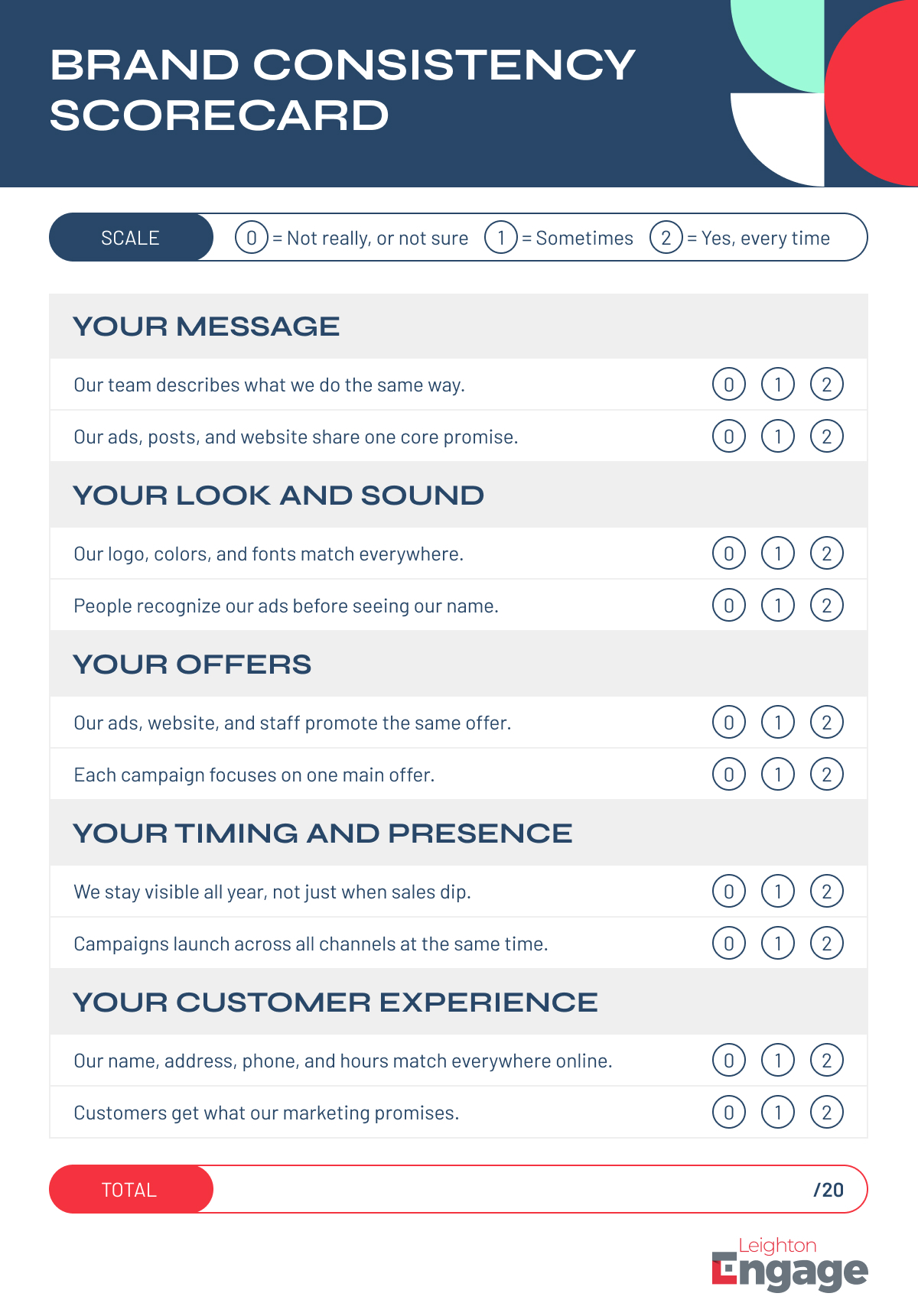
Score each statement using this scale:
2 = Yes, every time
1 = Sometimes
0 = Not really, or I'm not sure
Be honest. "I'm not sure" counts as a zero, because if you can't tell, your customers probably can't either.
Your message
1. If you asked three people on your team what we do and why customers choose us, they'd give the same answer.
2. Our ads, social posts, and website homepage all lead with the same core promise.
Your look and sound
3. Our logo, colors, and fonts match across our website, social profiles, signage, and printed materials.
4. Someone could recognize one of our ads before they saw our name. Think colors, imagery, a familiar voice, or a sound people associate with you.
Your offers
5. The promotion in our ads matches what our website shows and what our staff says when customers ask about it.
6. Each campaign focuses on one main offer instead of stacking several at once.
Your timing and presence
7. We stay visible all year, not just when sales slow down.
8. When we launch a campaign, it goes live across channels at the same time instead of whenever each piece is ready.
Your customer experience
9. Our business name, address, phone number, and hours are identical on Google, our website, social media, and online directories.
10. What our marketing promises is what customers actually experience when they call, click, or walk in.
What does your brand consistency score mean?
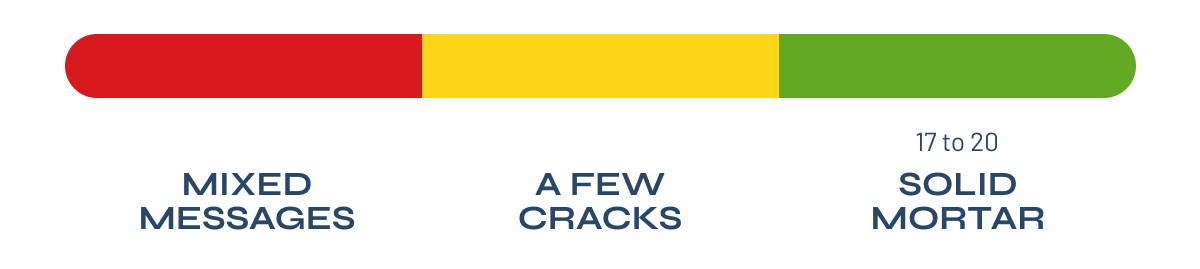
17 to 20: Solid mortar. Your brand holds together. Customers know what to expect from you, which makes every new campaign easier to recognize and act on. Your focus for next year is protecting that consistency as you add new channels or offers.
11 to 16: A few cracks. Most of your brand is working, but a couple of areas are drifting. The fixes are usually specific and manageable. Look at your lowest-scoring category first.
0 to 10: Mixed messages. Customers are likely getting different versions of your business depending on where they find you. That doesn't mean your marketing is failing. It means each channel is doing its own thing, and the results aren't adding up the way they could.
Not sure how to read your results? Bring your score to a meeting with an Engage Digital Marketing Strategist and we'll walk through it with you.
How do you fix inconsistent branding?
Don't try to fix everything at once. Pick your lowest-scoring category and start there.
If your message scored low, write one sentence that explains what you do and why customers choose you. Share it with your team and use it as the starting point for every ad, post, and page. If you use AI tools to write content, give them that sentence too, so you don't end up sounding like everyone else.
If your look and sound scored low, gather your logo files, colors, and fonts in one place and share them with anyone who creates content for you, including vendors and media partners. Recognition builds when the same visual and audio cues show up again and again.
If your offers scored low, choose one primary offer per campaign. Before it launches, confirm the website and your front-line staff are ready to talk about it.
If your timing scored low, plan a simple year-round baseline presence so you're not starting from zero every time you need results. Showing up regularly matters more than being perfect, which is also how video builds real brand affinity. Then coordinate launch dates so every channel goes live together. Pairing channels like radio and digital works best when they share a message and a schedule.
If your customer experience scored low, start with your business listings. According to Google's own guidance, businesses with complete and accurate information are more likely to show up in local search results. AI search tools pull information from across the web too, so the same mixed signals can make your business harder for them to describe accurately. Your website matters here as well. Our Local Business Website AEO Audit Checklist helps you check whether your site clearly answers customer questions and is set up for AI and voice search.
How to use your score to plan next year's marketing
The best time to fix mixed messages is before you plan your next round of campaigns, not after. Before you map out next year's promotions, name your mortar: the three to five things that should stay the same no matter what you're promoting. Then build every new campaign on top of it, as part of a content strategy that connects each piece to the next.
Once your campaigns are running, track whether consistency is paying off. Focus on the marketing KPIs that matter, like leads and conversions, rather than likes and impressions.
Individual campaigns will change throughout the year, and they should. The brand underneath them shouldn't. Staying consistent is what turns a series of separate ads into a business people recognize, remember, and choose.
FAQ
What is a brand consistency checklist?
A brand consistency checklist is a short set of questions that helps you see whether your business looks, sounds, and behaves the same way across every channel. It covers your message, visuals, offers, timing, and customer experience, not just your logo.
How do I know if my business is sending mixed messages?
Look at your ads, website, social media, and Google listing side by side. If the core promise, offer, look, or business details differ from one to the next, customers are getting mixed messages. Scoring 10 or below on the scorecard above is another clear sign.
How often should I review my brand consistency?
A quick review once or twice a year works for most small businesses. It's also worth running before any major campaign, new service launch, or website update so new messages build on your brand instead of pulling away from it.
Does brand consistency mean running the same ad over and over?
No. Consistency is about keeping your core elements steady while your individual messages change. You can promote a different offer every month and still be consistent, as long as your voice, look, and customer promise stay the same.
What's the difference between a brand audit and a brand consistency check?
A full brand audit looks at your brand's positioning, reputation, and competitive landscape in depth. A brand consistency check is narrower and faster. It focuses on whether what you already have shows up the same way everywhere.
Turn your score into a consistent messaging plan
A scorecard shows you where the gaps are. A plan helps you close them without starting over. Our team can help you name your mortar, line up your channels, and build next year's campaigns around a message customers will recognize. Learn more about our strategy, training, and tools, or talk it through with us directly.
Schedule a meeting with an Engage Digital Marketing Strategist to discuss what a consistent messaging strategy looks like for your business.


Leave a Comment